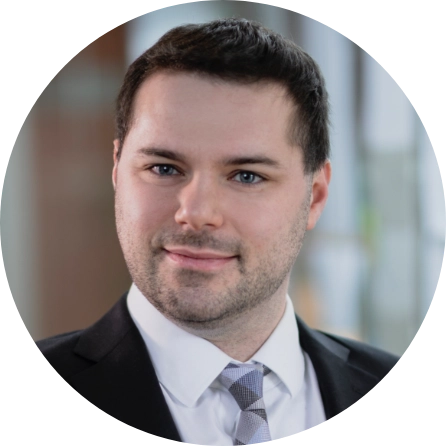
Paul D. Martin, Ph.D.
Dr. Martin is a Lecturer in Computer Science at Johns Hopkins University and the Chief Scientist at Harbor Experts. He serves as both a testifying and consulting expert in software, cybersecurity, artificial intelligence, embedded systems, and hardware-related litigation. Most of his expert work involves patents, where he addresses claim construction, infringement and non-infringement, validity, prior art, and how products actually implement the technology at issue. Trade-secret disputes, which turn on software copying and derivation, development history, and technical provenance, are another major part of his practice. His work focuses on helping attorneys, courts, and juries understand technical systems and the evidence they produce in high-stakes disputes. He serves as Secretary of the IEEE 7024 Working Group, which is developing the standard for the procurement, verification and validation, and life cycle management of forensic technologies.
He has provided expert testimony in federal and state courts, the International Trade Commission, and inter partes reviews, in civil matters, criminal proceedings, and international disputes. Across more than one hundred matters, he has led large-scale source code reviews of systems ranging from thousands to billions of lines of code, reconstructing system behavior, development history, and technical provenance.
He earned his B.S., M.S.E., and Ph.D. in Computer Science from Johns Hopkins University, where his doctoral research, advised by Dr. Aviel D. Rubin, focused on securing medical devices and protecting patient privacy. He is a named inventor on five U.S. patents, a published researcher in embedded security and applied cryptography, and a former member of the program committee for the IEEE Symposium on Security and Privacy.
Expert Witness
What sets Dr. Martin’s practice apart is that he is not only an analyst. He has built the kinds of systems he is retained to examine, including production code in FDA-regulated medical devices. He also designs custom experiments to answer the questions in dispute and reconstructs system behavior from binaries when source code is lost or unavailable.
His litigation record to date:
- 20 testimony appearances
- 14 depositions
- 4 trials
- 2 evidentiary hearings
- 100+ large-scale source code reviews
Dr. Martin accepts expert witness and consulting engagements through Harbor Experts.
View expert witness experience →
Research & Innovation
Dr. Martin’s research and engineering span source code analysis, security and cryptography, performance measurement, virtualization and hosting infrastructure, and full-stack systems engineering from hardware through application software. His current focus is software supply-chain security: in a modern supply chain, a component’s version number can be a poor guide to whether it is actually vulnerable, because enterprise Linux distributions ship soft-forked packages whose backports can leave real exposure out of step with upstream. His research measures how far those distributions diverge from upstream and how large the resulting gap in exposure is.
He designed and led development of Firmware IQ, a commercial platform that scans firmware, containers, and virtual machine images for known vulnerabilities against NIST’s National Vulnerability Database, and Sentinel, a CPU add-on that enforces control-flow integrity on embedded devices; earlier systems he built were patented by Accenture and commercialized by Applied Communication Sciences.
In 2026 he released Technicomp Benchtop Linux, the operating system for the technical workbench: an immutable, stabilized workstation rolling release derived from openSUSE Aeon and built on Tumbleweed. Its release model is one of the questions his research examines: whether tracking upstream closely, while stabilizing only the kernel and desktop, narrows the gap. The research runs on virtualization and hosting infrastructure he designs and operates for security research, AI inference, and expert engagements, informed by more than twenty years of performance measurement and tuning.
Teaching
At Johns Hopkins, Dr. Martin teaches C and C++ programming, computer and network security, and applied cryptography — courses built around hands-on analysis of real codebases, the same discipline he applies in litigation. He co-instructed a short course on hardware hacking and received the Computer Science Department’s Outstanding Teaching Assistant Award in 2014.
Selected Work
Dr. Martin has hands-on experience across dozens of CPU architectures, from 8-bit processors (e.g., 6502, 8051, Z80, PIC) through embedded systems (e.g., AVR, MSP430) to workstation- and server-class systems (e.g., x86-64, ARM, MIPS, SPARC, PowerPC), and maintains a hardware analysis laboratory equipped with oscilloscopes, logic analyzers, microscopes, soldering and rework stations, and other diagnostic equipment used for component-level hardware investigation, firmware extraction, and forensic analysis.
In the Media
The Asbury Park Press — photo chronology of the State of New Jersey v. Paul Caneiro case (April 2026)
The Asbury Park Press — reporting on Dr. Martin’s testimony: “DNA software used in Caneiro murder case is ‘quite good,’ expert says” (December 2024)
Al Jazeera America and Al Jazeera English (international) — television interview on medical device security (February 13, 2015)
The Washington Post — coverage of a Johns Hopkins University intersession course on Facebook application development (February 2009)
The Baltimore Sun — coverage of a Johns Hopkins University intersession course on Facebook application development (February 2009)
Dr. Martin also runs Technicomp Labs, his independent lab and the home of Technicomp Benchtop Linux, the operating system for the technical workbench. The site also hosts his independent technical blog, open-source projects, performance research, hardware restorations, and a museum archive of vintage computers and game consoles. Technicomp Labs is separate from his professional and expert witness work.